
ENOB, SNR and Resolution Are Not the Same Thing
You paid for twelve bits. The datasheet quietly tells you how many you get.
- Lesson 4 of 4
- Advanced
The front page says twelve bits. Somewhere in the dynamic performance table there is a number like 68 dB, and that number quietly tells you the part behaves like an eleven-bit converter.
Nobody is lying. Resolution and accuracy are different specifications and both are honest. The problem is that only one of them is on the front page.
Quick answer. Resolution is how many codes exist. SNR is how far the signal is above the noise. SINAD is the same but counts harmonic distortion as well as noise. ENOB converts SINAD back into bits with
ENOB = (SINAD − 1.76) / 6.02, and it tells you how many bits are actually trustworthy. A 12-bit part with 68 dB of SINAD gives you 11.0 effective bits, so its real step is not 806 µV but 1.61 mV.
Where 6.02 and 1.76 come from
This relation gets quoted constantly and derived rarely, which is a pity because the derivation is three lines and it tells you exactly when the formula does not apply.
Take a perfect N-bit converter with step size q. Its full-scale range is 2^N · q. Feed it a sine wave that exactly fills that range. The amplitude is half the range, and the RMS value of a sine is its amplitude over root two:
signal RMS = (2^N · q / 2) / √2The only error a perfect converter makes is quantisation, and that error is uniformly distributed across one step, whose RMS value is:
noise RMS = q / √12Divide and take twenty times the logarithm:
SNR = 20 · log10( 2^N · √12 / (2·√2) )
    = 6.02 · N + 1.76 dB
For our 12-bit converter that is 74.0 dB.
Two conditions are hiding in that derivation, and both matter in practice:
- The signal is a full-scale sine. Run at a tenth of full scale and your
signal is 20 dB lower while the noise is unchanged, so your usable SNR is 20 dB worse. SNR is a specification of the converter; the ratio you get is a property of how much of the range you use.
- The only error is quantisation. Everything a real part adds pushes the
number down from there, never up.
A consistency check worth doing once: the noise implied by 74 dB on a 3.3 V range is 233 µV RMS, and q/√12 for an 806 µV step is also 233 µV. The two routes agree, which is a sign the units are right.
SNR, THD, SINAD and ENOB
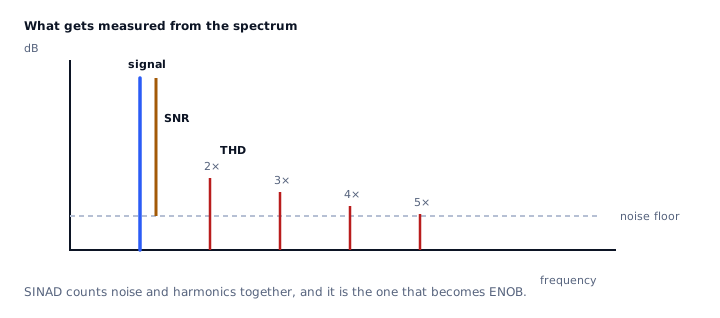
The figure is the spectrum of a converter fed a single clean sine. Four quantities are measured from it:
| Quantity | What it measures |
|---|---|
| SNR | signal against the noise floor, excluding harmonics |
| THD | the harmonics against the signal |
| SINAD | signal against noise and harmonics together |
| ENOB | SINAD expressed as a number of bits |
SINAD is the one to specify against, because a converter that is quiet but non-linear and one that is linear but noisy are equally wrong by the time the number reaches your software. ENOB is just SINAD in friendlier units:
ENOB = (SINAD − 1.76) / 6.02Worked on the course example, with a datasheet SINAD of 68 dB:
ENOB = (68 − 1.76) / 6.02 = 11.0 bitsAnd the honest step size is then:
3.3 V / 2^11 = 1.61 mVTwice the nominal 806 µV. Every error budget in this course that was quoted in codes should be read against the real step, not the nominal one.
Effective resolution and noise-free bits
Delta-sigma datasheets usually give two more numbers, and the difference between them trips people up.
- Effective resolution is derived from RMS noise.
- Noise-free bits, sometimes called flicker-free resolution, is derived
from peak-to-peak noise.
Peak-to-peak noise over a reasonable observation is about 6.6 times the RMS value, and log2(6.6) is 2.72, so:
noise-free bits ≈ effective resolution − 2.7A part advertising 21.5 bits of effective resolution gives roughly 18.8 noise-free bits. If what you need is a reading that does not visibly flicker on a display, noise-free is the number that matters, and it is about three bits worse than the one in the marketing table.
What this changes about choosing a part
The practical consequence is an ordering, and it is the opposite of the usual instinct.
- A 16-bit part with 78 dB of SINAD gives 12.7 effective bits.
- A 12-bit part with 71 dB of SINAD gives 11.5 effective bits.
The sixteen-bit part is better, but by 1.2 bits, not by four. You paid for four and the architecture delivered one. Whether that is worth it depends entirely on whether 1.2 bits moves your measurement, and that question can only be answered in microvolts at the input.
Worth saying plainly: none of this means datasheets are deceptive. The specifications are all there and they are all defined. It means the front page answers a different question from the one you are asking.
What comes next
Lesson 5 leaves the specification table and looks at what the converter's input actually does to the circuit driving it, which is where a surprising amount of real-world error is manufactured.
Sources and further reading
- Texas Instruments: A Glossary of Analog-to-Digital Specifications and Performance Measures (SBAA147) — application report, precise definitions of SNR, SINAD, THD and ENOB and how each is measured.
- Microchip: AN693 Understanding A/D Converter Performance Specifications — application note, the dynamic specifications and the conditions attached to them.
- Texas Instruments: Understanding Data Converters (SLAA013) — application report, quantisation noise as the floor the whole calculation starts from.
- Texas Instruments: High-Speed, Analog-to-Digital Converter Basics (SLAA510) — application report, the same measures applied where they bite hardest.