
ADC Resolution: What the Number of Bits Really Means
Twelve bits buys you a step size, and a step size is not an accuracy.
- Lesson 1 of 1
- Advanced
A sixteen-bit converter is not more accurate than a twelve-bit one. It is finer. Those are different claims, and the gap between them is where most measurement disappointments live.
Resolution tells you the size of the smallest step the converter can report. It tells you nothing at all about whether the step lands where it should, or whether the thing you are measuring is steady enough for the step size to matter.
Quick answer. Resolution is the number of distinct codes a converter produces, which is 2 raised to the number of bits. Divide the input range by that and you get the step size, usually called one LSB. A 12-bit converter on a 3.3 V reference has 4096 codes and a step of 806 microvolts. That number is a property of the ruler, not of the measurement: noise, offset, gain error and drift all still apply on top of it.
From bits to microvolts
The only arithmetic in this lesson, and it is the one worth internalising:
codes = 2^N
1 LSB = full-scale range / 2^N
For the front end this course inherits, a 12-bit converter with a 3.3 V reference:
codes = 2^12 = 4096
1 LSB = 3.3 / 4096 = 805.7 µV
Call it 806 µV. Every error in the rest of this course gets quoted in those units, because an error in volts means nothing until you know what a code is worth.
Going the other way is just as useful. An error of 17.85 mV at the output of a gain stage is:
17.85 mV / 806 µV = 22 codesTwenty-two codes of a four-thousand-code range. That is a far more honest description of the damage than "about eighteen millivolts".
Resolution is about the range, not about the part
Here is the comparison that breaks the habit of reading bits as quality.
| Converter | Range | 1 LSB |
|---|---|---|
| 16-bit | 10 V | 153 µV |
| 12-bit | 100 mV | 24 µV |
The twelve-bit converter resolves six times finer than the sixteen-bit one, because resolution is the range divided by the codes and the range is a design decision.
This is why "we need 16 bits" is not a requirement. The requirement is the smallest difference you need to tell apart, in volts at the converter's input. Bits are one of several ways to get there, and amplifying the signal so it fills the range is usually cheaper than buying bits.
What the step size does not tell you
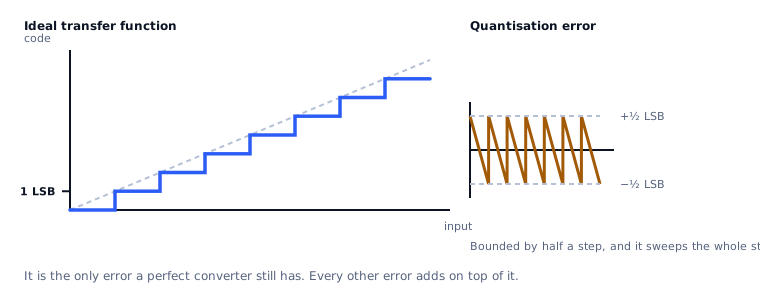
The figure shows the transfer function of an ideal converter: a staircase, and underneath it the error between the staircase and the straight line it approximates. That error is bounded by half a step and it sweeps across the full step as the input moves. It is called quantisation error, and it is the one error a perfect converter still has.
Everything else is extra:
- Offset error shifts the whole staircase sideways.
- Gain error tilts it.
- Differential non-linearity makes individual steps wider or narrower than
one LSB. A step of zero width is a missing code.
- Integral non-linearity bends the staircase away from a straight line.
- Noise, from the converter and from everything in front of it, spreads
each reading across several codes.
Offset and gain can be calibrated. The others largely cannot, and the last one is usually the largest.
When extra bits buy nothing
Take the front end from the amplifier course: a sensor signal amplified to a 2.38 V full scale, read by this 12-bit converter. Suppose the amplifier contributes 1 mV of noise at its output. That is:
1 mV / 806 µV = 1.24 codesSo each reading already wanders across roughly a code or two before the converter does anything wrong. Replacing the converter with a 16-bit part divides the step by sixteen, to 50 µV, and the same 1 mV of noise now spans:
1 mV / 50 µV = 20 codesYou have bought four bits of resolution and spent them all displaying the noise in more detail. The reading does not become more trustworthy. It becomes more precise about something that was never steady.
That is the single most useful idea in this course, and it has a direction: fix the noise first, then buy resolution, and only as much as the noise floor can support. Lesson 4 turns that into a number you can look up on a datasheet.
The honest way to specify a converter
Work from the measurement, not from the part.
- What is the smallest change you need to distinguish, in volts at the
sensor?
- What gain gets that change comfortably above the noise of the signal chain?
- What full-scale range does the amplified signal then need?
- Divide: how many codes does that require?
Only at the end does the answer come out as a number of bits, and it usually comes out smaller than the instinct that started the conversation.
A worked version: a sensor whose smallest meaningful change is 50 µV, over a 20 mV span, with a chain that contributes about 7 µV of noise. You want a few codes per meaningful change, so aim for roughly 10 µV per code across 20 mV:
20 mV / 10 µV = 2000 codes -> 11 bitsEleven bits at the sensor, which after a gain of 119 is twelve bits at the converter with room to spare. Nothing in that calculation started with a part number.
What comes next
Lesson 2 opens up the most common architecture and shows what a successive-approximation converter is actually doing during the microsecond you gave it, because the answer explains most of what the next four lessons are about.
Where the errors in front of the converter come from, and how they multiply on their way to it, is the subject of the input offset lesson in the operational amplifier course.
Sources and further reading
- Texas Instruments: Understanding Data Converters (SLAA013) — application report, quantisation, the ideal transfer function and the error terms around it.
- Texas Instruments: A Glossary of Analog-to-Digital Specifications and Performance Measures (SBAA147) — application report, precise definitions of resolution, offset, gain, DNL and INL.
- Microchip: AN693 Understanding A/D Converter Performance Specifications — application note, what each specification constrains in a real measurement.
- Microchip: AN1152 Achieving Higher ADC Resolution Using Oversampling — application note, why the usable resolution and the nominal resolution are different quantities.