
Delta-Sigma ADCs: Resolution, Oversampling and Latency
You buy twenty-four bits with time, and time is what the control loop wanted.
- Lesson 3 of 3
- Advanced
A twenty-four bit converter does not have a twenty-four bit comparator in it. It has a one-bit comparator running very fast, and a digital filter that turns a great many crude measurements into one fine one.
That is a good trade when you have time to spend and a bad one when you do not, and knowing which situation you are in is most of what choosing between architectures means.
Quick answer. A delta-sigma converter samples far faster than it needs to, which spreads quantisation noise over a wide band, and shapes that noise so most of it lands above the band you care about. A digital filter then removes the part you do not want, keeping only the small fraction of noise left in your band. The resolution is bought with oversampling and filtering, and the price is latency: the filter needs several conversion periods before its output means anything.
Oversampling on its own
Start with the part that needs no cleverness. Quantisation noise power is fixed by the step size, and it spreads evenly across the band from DC to half the sampling rate. Sample faster and the same noise power is spread over more hertz, so there is less of it per hertz. Filter down to the band you actually want and you throw away the rest.
The improvement in signal-to-noise ratio is:
ΔSNR = 10 · log10(K) where K is the oversampling ratioOversampling by four gives 6.02 dB, which is exactly one extra bit. So:
K = 256 -> 10 · log10(256) = 24.1 dB -> 4 extra bitsTwo hundred and fifty-six samples averaged to produce one, for four bits. That is an expensive exchange rate, and it is why plain oversampling is a useful trick on a microcontroller's built-in SAR but not an architecture.
Noise shaping is what makes it an architecture
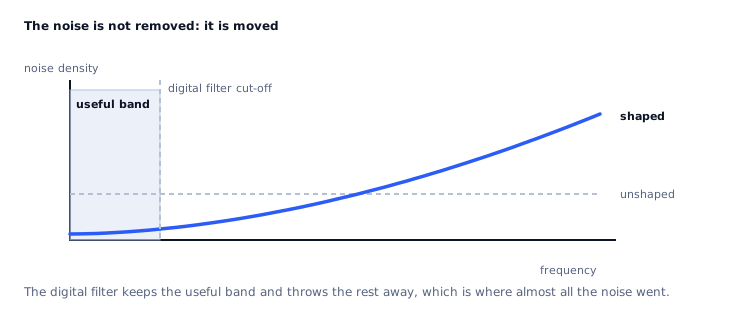
A delta-sigma modulator adds a feedback loop around the coarse quantiser. The loop has high gain at low frequency, so it suppresses the quantiser's own error there, and the error has to go somewhere: it reappears at high frequency. The noise is not reduced, it is moved, out of the band you are measuring and into the band you are about to filter away.
The improvement per doubling of the oversampling ratio depends on the order of the loop:
| Loop order | Per doubling of OSR | In bits |
|---|---|---|
| 0, plain oversampling | 3 dB | 0.5 |
| 1 | 9 dB | 1.5 |
| 2 | 15 dB | 2.5 |
| 3 | 21 dB | 3.5 |
That is the whole reason the architecture exists. A second-order loop buys five times as much per doubling as oversampling alone, which is what turns an absurd exchange rate into a practical one.
Higher order is not free: loops above second order need care to stay stable, and real parts manage it with specific topologies rather than by simply adding integrators.
The digital filter decides almost everything you notice
After the modulator there is a decimation filter, and in practice its behaviour is what you experience as the converter's personality.
It sets the latency. A sinc3 filter, which is the common default, needs three output periods to fully settle. At 20 samples per second:
3 / 20 SPS = 150 msA hundred and fifty milliseconds before a reading means anything. For a weigh scale that is invisible. For a current loop closing at a kilohertz it is disqualifying, and no amount of bits compensates.
It sets what gets rejected. A sinc filter has nulls at integer multiples of the output data rate. Choose an output rate of 10 SPS and there are nulls at 10, 20, 30 Hz and so on, which includes both 50 and 60 Hz. That is a real and widely used technique: mains interference is rejected by the filter rather than by a capacitor, and it works for both mains frequencies at once.
It sets what a channel change costs. The filter is a running computation over recent samples. Switch the multiplexer to another input and the first few outputs are a mixture of the two channels. Parts that support multiplexing either discard those outputs or offer a faster-settling filter mode, and either way the effective throughput per channel is far below the headline sample rate.
Choosing between the two architectures
| SAR | Delta-sigma | |
|---|---|---|
| Result corresponds to | one instant | an interval |
| Latency | essentially none | several conversion periods |
| Practical resolution | up to about 18 bits | 24 bits and beyond |
| Multiplexing | natural | costly, filter must refill |
| Noise in band | whatever arrives, unfiltered | filtered by the decimator |
| Mains rejection | needs analog filtering | often free, by filter nulls |
| Good at | control loops, multiplexed scanning | bridges, temperature, slow precision |
The question that decides it is not "how many bits do I need" but "does the answer have to correspond to a single instant?" If a reading must line up with a control decision, or with a specific sample of another channel, the interval-averaging behaviour of a delta-sigma is wrong no matter how good its noise is.
The claim worth refusing
"Twenty-four bits" on a delta-sigma datasheet is a count of output bits, not a promise about how many of them are stable. Most parts specify both, often as noise-free bits or effective resolution, and the gap between the two can be six bits or more at the fastest data rates. Reading the output-rate table rather than the front page is the entire difference between specifying the part and being sold it.
That gap is the subject of the next lesson.
What comes next
Lesson 4 gives the vocabulary for exactly this: SNR, SINAD and the effective number of bits, where the famous 6.02 comes from, and how to turn a decibel figure back into microvolts at the input.
Sources and further reading
- Texas Instruments: How delta-sigma ADCs work, Part 1 (SLYT423) — journal article, the modulator loop, oversampling and where the shaped noise goes.
- Texas Instruments: Digital Filter Types in Delta-Sigma ADCs (SBAA230) — application note, sinc and other decimation filters, their settling and their nulls.
- Microchip: AN1152 Achieving Higher ADC Resolution Using Oversampling — application note, the arithmetic of plain oversampling and what it does and does not buy.
- Texas Instruments: Understanding Data Converters (SLAA013) — application report, the architectures side by side and the quantisation noise they start from.