
SAR ADCs: How Successive Approximation Works
Twelve yes-or-no questions, and every one of them has to settle before the next.
- Lesson 2 of 2
- Advanced
Give a successive-approximation converter one microsecond and it does not measure your signal for a microsecond. It takes a snapshot in a few tens of nanoseconds, disconnects from your circuit entirely, and then spends the rest of the time interrogating that snapshot with a sequence of yes-or-no questions.
Almost everything surprising about SAR converters follows from that separation. The input behaves one way while it is sampling and a completely different way while it is converting.
Quick answer. A SAR converter performs a binary search. It compares the sampled input against half the reference, records whether it is above or below, then against a quarter, an eighth, and so on, one comparison per bit. Twelve bits means exactly twelve decisions, each of which has to settle before the next one starts. The input is only connected to your circuit during the acquisition window at the beginning.
The binary search
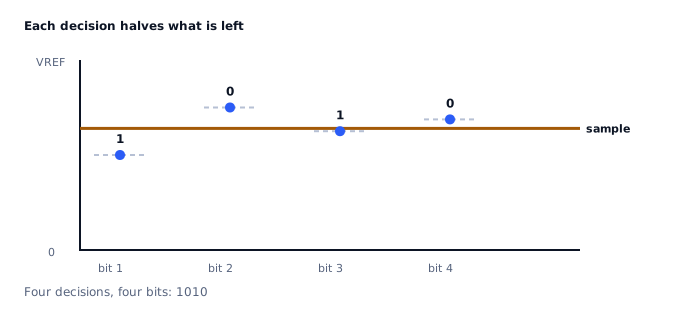
The figure follows four bits of a conversion. The first decision asks whether the sample is above or below half the reference, which splits the range in two. The second splits the remaining half. Each decision halves the uncertainty, so after N decisions the uncertainty is the range divided by 2 to the N, which is one LSB.
That is why a SAR needs exactly one comparison per bit, and why its conversion time scales linearly with resolution rather than exponentially. It is also why every extra bit costs the same again in time: the twelfth decision takes as long as the first.
It is a capacitor array, not a resistor ladder
The textbook drawing of a SAR shows a DAC and a comparator. Most real parts implement the DAC as a binary-weighted capacitor array that does double duty: it is both the sampling capacitor and the digital-to-analog converter.
During acquisition, all the capacitors in the array are connected to the input and charge to the input voltage. When the sample is taken, the input switch opens and the array holds that charge. The conversion then proceeds by switching individual capacitors between the reference and ground, which redistributes the stored charge and moves the comparator's input by a calculated amount. The comparator reports which way it moved, and that is the bit.
Three consequences that matter to the circuit outside:
- The input capacitance is real and it is switched. The array has to be
charged from your circuit at the start of every conversion. Lesson 5 works out what that costs.
- The reference is in the signal path, not just a parameter. Every
decision connects capacitors to the reference, so the reference supplies charge during the conversion and has to recover between decisions. Lesson 7 is about what that demands.
- There is no averaging. The output is a measurement of one instant. Any
noise present during the acquisition window is in the answer at full strength, which is the opposite of how a delta-sigma converter behaves.
The time budget
A conversion has two parts, and they compete:
| Phase | What happens | What it needs |
|---|---|---|
| Acquisition | input switch closed, array charges to the input | the source must settle the array to within half an LSB |
| Conversion | input switch open, N comparisons | each decision must settle before the next |
For the 12-bit converter this course uses, suppose the datasheet allows 300 ns of acquisition. Settling to half an LSB of 12 bits means settling to one part in 2 to the 13:
n = ln(2^13) = 9.01 time constants
τ ≤ 300 ns / 9.01 = 33.3 ns
Thirty-three nanoseconds of RC, for everything between your amplifier and the array. That single number is the whole design constraint of lesson 6, and it is why the obvious reflex of putting a large filter capacitor at the ADC input causes problems rather than solving them.
Note where the 9.01 came from: settling to half an LSB of an N-bit converter needs about ln(2^(N+1)) time constants, which is roughly 0.69 × (N + 1). A 16-bit part needs about 11.8, a 10-bit part about 7.6. More bits costs more settling time even when nothing else changes.
What it is good at, and what it is not
SAR converters sit in a particular place:
- One conversion, one answer, no latency. The result corresponds to a
single known instant and arrives immediately. That is what makes them the default in control loops and in multiplexed measurement.
- Easy to multiplex. Because each conversion is independent, you can
switch the input between channels between conversions. A delta-sigma cannot do this without discarding results while its filter refills.
- Resolution has a practical ceiling. The capacitor array has to be
matched to the resolution you want, and matching gets expensive quickly above sixteen to eighteen bits.
- It does not average for you. If you want the noise reduced, you have to
oversample and average in software, and then you have given up the latency advantage you came for.
That last pair is the trade the next lesson is about.
The failure that looks like noise
When a SAR gives readings that jump by far more than a code, the instinct is to blame noise. Often the real cause is that the acquisition window was not long enough for the array to charge, so each conversion starts from a slightly different residue of the previous one.
The tell is that the error depends on what the previous channel or sample was. A multiplexed system reading a 0 V channel right after a 3 V channel, with an input that does not settle, will read the 0 V channel high. Swap the order and the error changes. Noise does not behave that way.
What comes next
Lesson 3 takes the other common architecture, which solves the noise problem by spending time, and explains exactly what that time buys and what it costs.
Sources and further reading
- Microchip: AN246 Driving the Analog Inputs of a SAR A/D Converter — application note, the charge-redistribution array, the sampling capacitor and the source resistance that charges it.
- Texas Instruments: Understanding Data Converters (SLAA013) — application report, the successive-approximation algorithm and its place among the architectures.
- Texas Instruments: A Glossary of Analog-to-Digital Specifications and Performance Measures (SBAA147) — application report, acquisition time, conversion time and the specifications that bound them.
- Microchip: AN693 Understanding A/D Converter Performance Specifications — application note, the DC error terms a SAR carries and which of them calibration can reach.